
Near-Field Measurements: From Exploration to Artificial Intelligence
To mark the 20th anniversary of our collaborative innovation projects, we’re bringing you a series of articles chronicling NEXIO’s major technological adventures. First installment: near-field measurements, a topic that perfectly illustrates our approach—from exploratory research to the BAT-Scanner industrial product, and already geared toward artificial intelligence.
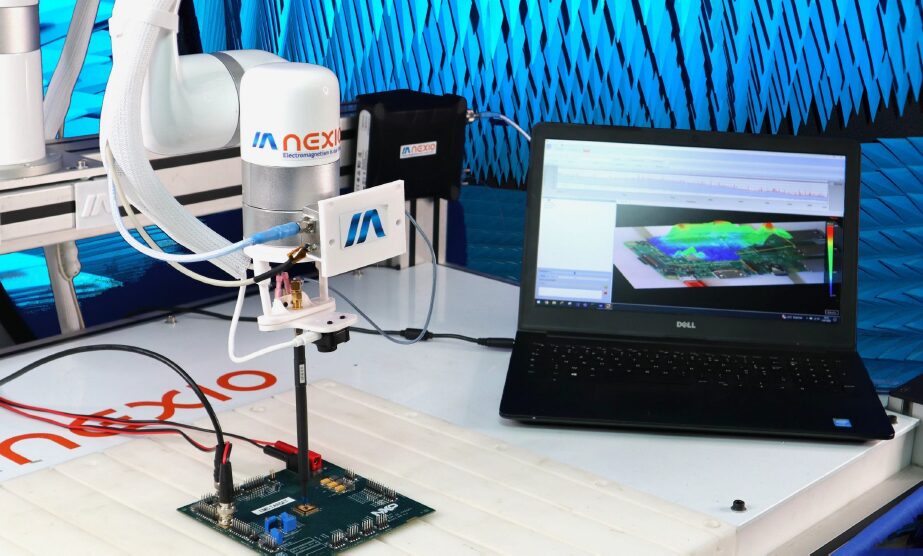
Near-field scanning (NFS) involves mapping the emitted electromagnetic fields or susceptibility zones a few millimeters above a circuit board or electronic equipment. It enables the precise identification of interference sources, aids in circuit design, and helps investigate EMC non-conformities. Twenty years of collaborative projects and in-house development have helped transform this laboratory technique into an industrial tool.
EPEA, our first collaborative innovation project
It all began with the EPEA project (2007–2010): our very first collaborative innovation project. It brought together 15 partners—large corporations, small and medium-sized enterprises, and research centers. EPEA aimed to define EMC engineering tools and measurement methods for the development of simulation models. It was within this framework that the first operational near-field measurement bench—including both software and hardware—was developed. EPEA also led the development of a service platform for manufacturers, which NEXIO managed, and contributed to international standardization: the near-field measurement exchange format, co-developed with the IEC, led to the creation of the IEC 61967-1-1 Ed. 1.0 standard in 2009.
From Application to Correlation: PCB², SEISME, LOCRAY
The following projects put this technology to the test in real-world conditions. PCB² and then SEISME (2011–2014), dedicated to the virtual prototyping of electronic equipment, used near-field measurements to extract models of components and circuit boards. At the same time, the EFT-SAFE3A project (2014–2017) opened up an entirely new front: Focused on the robustness of electronic systems against high-power fast transients, it led to the first explorations of near-field technology applied to immunity, by developing measurement, injection, and modeling methods at the component and system levels. With LOCRAY (2014–2018), a decisive milestone was reached: establishing a link between near-field investigative measurements and standardized qualification measurements, using a correlation method and software. Objective: to predict qualification measurements through post-processing of near-field data, and to make the technology accessible beyond just specialists in electromagnetics.
BAT-Scanner: From the Research Lab to an Industrial Product
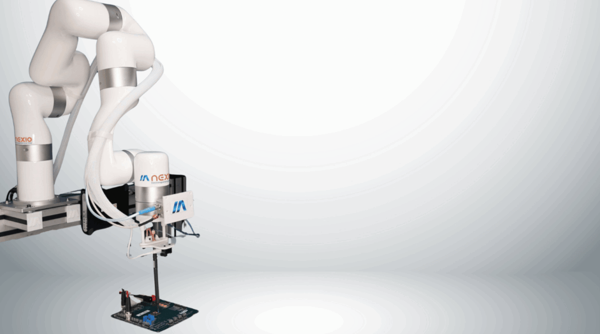
The progress made on these projects has fueled the development of BAT-Scanner, which automates near-field testing. In addition to collaborative R&D projects, NEXIO has used its own funds to develop, industrialize, and commercialize BAT-Scanner, gradually incorporating the advancements resulting from these projects. This investment has made it possible to transform research results into a solution that manufacturers can use. Its software is integrated into the BAT-EMC suite, the leading software for automating EMC testing. It controls a multi-axis robotic test bench and a wide range of measurement devices to map the emissions from a printed circuit board. NEXIO was thus the first company to industrialize near-field EMC measurements using a 3D scanner and has since been offering industrial near-field emission measurement services.
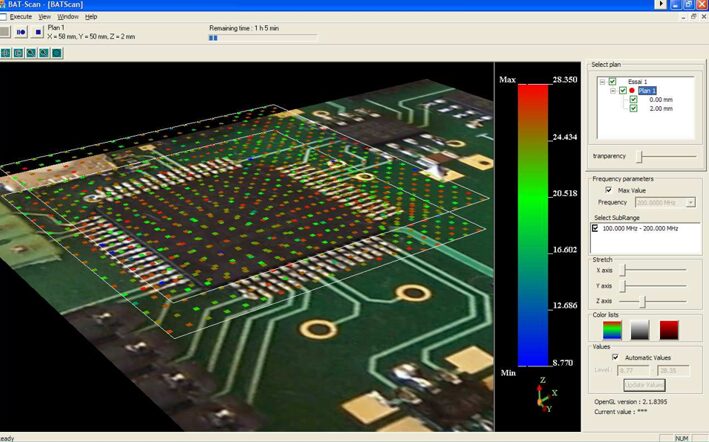
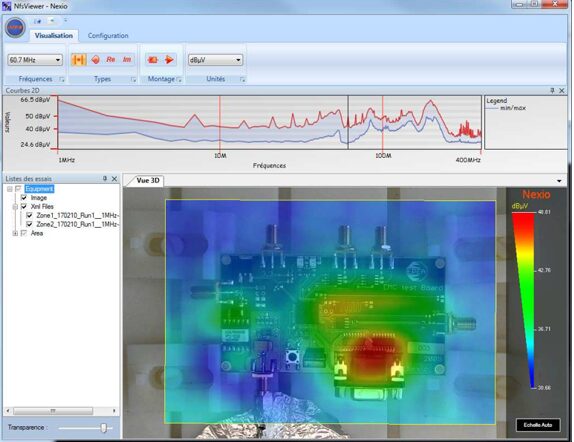
BAT-Scanner incorporates specialized features derived directly from our R&D projects: defining measurement areas and planes on the product image with just a few clicks, “Progressive Scan” provides a very quick overview of hot spots, vector measurements of amplitude and phase, and visualization of results in 3D mapping overlaid on a map. As the first software compatible with the IEC 61967-1-1 standard format, it enables—via its post-processing companion, NFS Viewer—the exchange of results and their direct use in numerical simulation software: a bridge between the worlds of measurement and simulation.
These developments are now being put to practical use in industry, ranging from the investigation of EMC nonconformities to the management of obsolescence. Four examples are presented in the appendix.
FELINE: Scale up production, validate immunity
The FELINE project (2019–2022), conducted in collaboration with IRT Saint Exupéry and numerous aerospace and automotive manufacturers, has advanced this initiative on two fronts: the industrialization of NFS emission testing (NFSe) for investigating radiated emissions and aiding in design, and the validation of NFS immunity testing (NFSi) for investigating radiated immunity on electronic circuit boards. Near-field immunity—identifying sensitive areas on a circuit board rather than its emission sources—opened up a new field of application for BAT-Scanner.
CEMASURF: Industrialized Immunity and Artificial Intelligence
Since 2025, we have been participating in the CEMASURF project (Electromagnetic Compatibility and Operational Safety of Onboard Electronics), funded by BPI France (i-Demo) and certified by the Aerospace Valley cluster, alongside NXP (project leader), INSA-LAAS, G2ELAB, and AIRBUS. The project aims to predict the impact of electromagnetic disturbances on the operational safety of electronic systems by combining automated EMC testing, fault injection, and data analysis.
In the near field, CEMASURF has a twofold goal. First, to continue our efforts to industrialize near-field immunity (NFSi) by incorporating advancements from LAAS: following the launch of the transmission feature, it is now immunity’s turn to be added to the BAT-Scanner offering and to transition from the laboratory to an industrial-scale solution. Second, to explore the potential of artificial intelligence: In 2026, we began working with a doctoral student on a project aimed at using AI to extrapolate near-field measurements to the far field—that is, to predict, based on a BAT-Scanner scan performed on a test bench, the equipment’s behavior during a standardized chamber test. This approach directly extends LOCRAY’s goal of correlation, leveraging machine learning techniques.
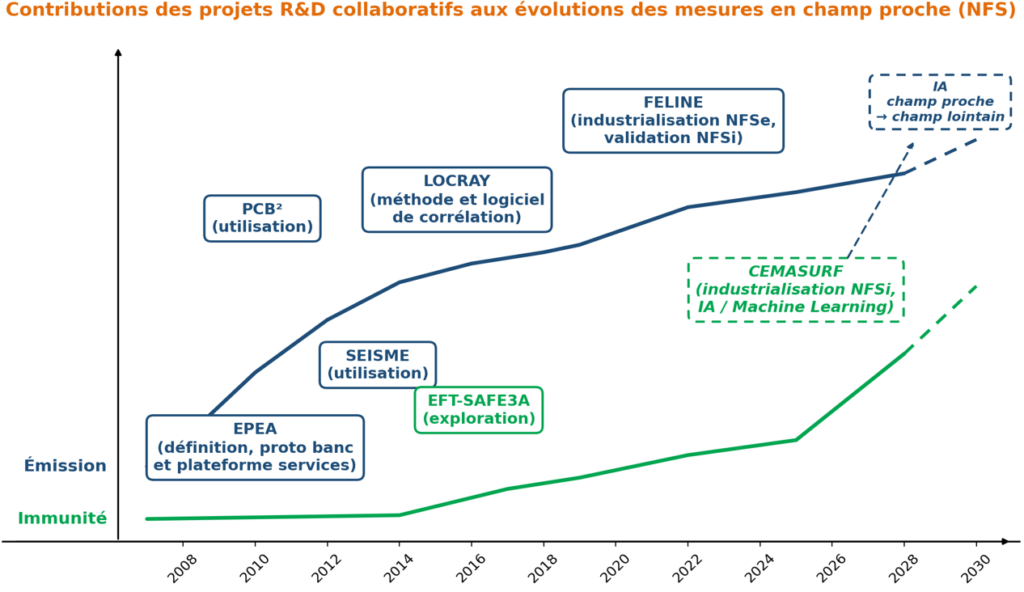
Twenty Years of Evolution in One Graph
The timeline below outlines the contribution of each of these projects to technical advancements in NFS measurements, in both the emission and immunity areas. It illustrates the logic behind our collaborative projects: each project builds on the previous one, from exploration to definition, from application to industrialization—and now toward prediction using AI.
Conclusion
From EPEA to CEMASURF, near-field measurement encapsulates twenty years of our innovation model: collaborative projects bringing together industrial partners, small and medium-sized enterprises, and academic laboratories, supported by public funding and extended through in-house development to integrate these advancements into our products and bring them to market. BAT-Scanner is the most visible embodiment of this approach: its development path combines collaborative research, in-house investment, industrialization, and commercialization. The next chapter is already taking shape: industrialized immunity and near-field/far-field extrapolation using AI are shaping the future of EMC testing—faster, more predictive, and accessible from the design stage onward.
The partners in this adventure
This path has been forged in collaboration with our industrial and academic partners. We would like to thank all the partners in the EPEA, PCB², SEISME, EFT-SAFE3A, LOCRAY, FELINE, and CEMASURF projects for their contributions to the advances presented in this article.
FELINE: IRT Saint Exupéry, alongside aerospace and automotive manufacturers involved in the project.
CEMASURF: NXP (project leader), INSA-LAAS, G2ELAB, and AIRBUS, alongside NEXIO. The project is funded by Bpifrance as part of the i-Démo program and has been certified by Aerospace Valley.
Appendix: Four Examples of Industrial Applications of the Near Field
The four case studies presented below are based on projects NEXIO has carried out for its clients. They illustrate how near-field measurements can help resolve EMC nonconformities, guide design decisions, and support product development—either prior to or in addition to EMC validation testing.
Identify a malfunction in an aircraft computer. On an A350 flight computer exhibiting non-compliance with conducted emissions standards, electric field measurements taken near the connector made it possible to identify the pins carrying the interference within 30 minutes. The customer then traced the issue back to a connection between an internal function and a trace on the motherboard.
Repair shielding leaks without remaking the mold. When radiated emissions exceeded the limits specified in DO-160 RE2, a day of measurements taken around the openings of an enclosure—and then on the circuit boards accessible after opening it—allowed us to pinpoint the areas of weakness. These investigations led to cost-effective corrections—without requiring the manufacture of a new mold—while also laying the groundwork for the design of the next version.
Measuring the EMC benefit of a filter. In just half a day, a comparison of two versions of a product—one with and one without additional filtering on a DC/DC regulator—revealed a 10 dB reduction in measured emissions. This provided the customer with a precise measure of performance improvement to weigh against the cost of the modification.
Assist with the replacement of an obsolete component. A near-field comparison of two versions of a product revealed, in half a day, a 18 dB decrease at 2 MHz but an 11 dB increase at 100 MHz with the new component. These results made it possible to characterize the impact of the replacement as a function of frequency and to guide the requalification process.
These measures provide a localized diagnosis and facilitate technical decisions throughout the product’s life cycle. They complement EMC validation testing.

