
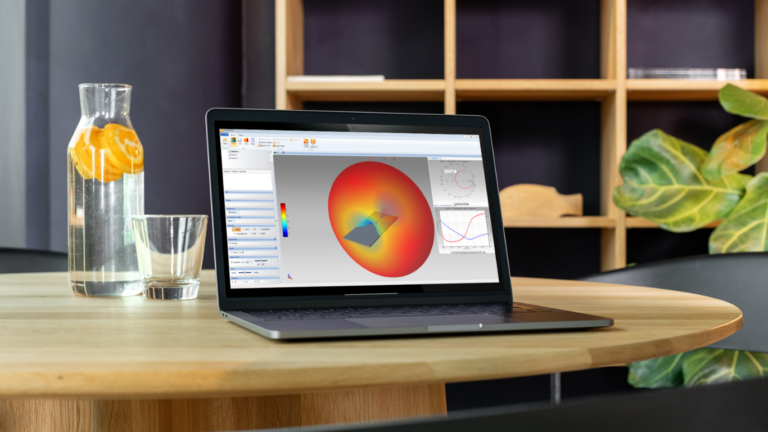
CAPITOLE: From High-Performance Computing to AI, Making Electromagnetic Simulation Accessible to All
20 Years of Collaborative Innovation at NEXIO
Following our coverage of near-field measurements, our series celebrating 20 years of innovation at NEXIO continues with CAPITOLE.
Its story began with a goal: to enable the electromagnetic simulation of complex structures on a PC, while making it easy for engineers in various fields to use. This initial innovation then paved the way for high-performance computing (HPC), enabling the processing of much larger models.
From general-purpose computing (PC) to high-performance computing (HPC), CAPITOLE has continued its research into specialized applications, ranging from radar signature to the consideration of the maritime environment. The accuracy of our results and their validation with our partners and customers remain a constant priority.
With ENR.IA, artificial intelligence and PINN approaches are opening up new avenues of research.
1. Make large-scale simulations possible on a PC
In the early 2010s, simulating an antenna installed on an aircraft or a ship, predicting a radar signature, or studying DREP/DRAM zoning on a large structure sometimes required considerable computing resources. The challenge was not only to perform calculations faster, but also to make these studies accessible using a personal computer.
The solvers developed combine, in particular, the method of moments (MoM) with ACA (Adaptive Cross Approximation) matrix compression. By reducing the volume of data to be stored and processed, this approach facilitates the analysis of electrically large structures. Complementary techniques, such as ACA-CBD, also improve resolution.
Initiated by ENTARES Engineering, this work was further developed in the A-SEAD project (2010–2012), supported by the DGA under the RAPID program. Together with NEXIO, LUN’TECH, and a contribution from the Polytechnic University of Catalonia, A-SEAD helped validate the methods and prepare for their industrialization within CAPITOLE-EM. The collaboration also marked the merger of ENTARES and NEXIO; ENTARES would become NEXIO Technologies.
A published example illustrates this accessibility: the SER of a 200-mm sphere, meshed at λ/10, is calculated in 36 seconds on a laptop with an Intel Core i7-7700HQ processor, using 1.9 GB of memory. See the PC demonstration.
2. From PC to HPC: Pushing Another Boundary
The effectiveness of fast solvers opens up a second avenue: by leveraging more powerful infrastructure, the same principles make it possible to tackle much larger models. High-performance computing (HPC) therefore builds on the initial ambition rather than running counter to it.
This evolution stems from collaborative programs, as well as internal developments and client projects. The European FORTISSIMO experiment is one such example: CAPITOLE-EM was deployed on a Bull platform for simulations of radar antennas and reflectors, while exploring the constraints of remote access and licensing.
Another published example: for the SER of a sphere between 5 and 8 GHz, 136,264 triangles were processed in 1 hr 15 min 18 s using MLACA on a Dell PowerEdge R920 server (48 cores and 512 GB of RAM). See the calculation parameters.
The following example illustrates the current capabilities and hardware requirements for simulating the radar cross-section (RCS) of a complex target—in this case, a modern fighter jet. The radar signature of this complex object is calculated at a frequency of 2.75 GHz using the HPC version of CAPITOLE EM’s ML-ACA solver on a computer (Linux server) equipped with 2 CPUs, each with 18 cores. The number of unknowns in this problem is approximately 5 million, requiring 634 gigabytes of memory and a computation time of 269 minutes. An extrapolation estimates the memory requirements at 30 terabytes for a calculation at 10 GHz.
3. Tackling Niche Technological Challenges
Rather than replicating all the features of general-purpose platforms, NEXIO develops methods tailored to challenging industrial problems: selecting the right physical representation, model, and solver for a specific application.
Radar signature and materials
The RAPID CAPITOLE-EM project (2012–2015), in collaboration with NEXIO Technologies and Airbus Group Innovations, improves the modeling of dielectric and absorptive materials, multiple reflections, and diffraction. Developments validated on complex targets have been integrated into CAPITOLE-RCS. SIMPLEXE is continuing this research with high-order surface impedance conditions (HOIBC), designed to represent certain absorptive materials without modeling their entire volume in detail; this work has notably produced a prototype, with the University of Cergy’s contribution yet to be precisely confirmed.
Complex Antennas and Systems
The interactions between an antenna and its host structure, cavities, or electromagnetic disturbances often require a combination of several methods. Research on equivalent models, system decomposition, and multiscale simulation—particularly in the SIMPLEXE project with the University of Limoges and ArianeGroup—explores these situations, which are difficult to address with a single model.
The maritime environment
In collaboration with ENR.IA and ZELIN, research focuses on the radar signature of ships, the modeling of sea states, and their interactions with structures. It also aims to improve PO/PTD approaches and absorptive materials through HOIBC. ENR.IA combines this maritime challenge with the study of AI in the simulation chain: neural network-based approaches, including PINNs, and surrogate models are avenues to explore for reducing certain computational costs without compromising accuracy. Their performance has yet to be demonstrated and validated.
This work builds on industrial applications already explored by NEXIO. See naval applications.
4. Accuracy and Validation: An Ongoing Requirement
A rapid simulation has industrial value only if its results are sufficiently reliable. Model accuracy, control of approximations, and comparison with measurements are therefore core areas of CAPITOLE’s R&D, not merely a final verification step.
NEXIO’s expertise in measurement and simulation is complemented by the experimental resources, industrial cases, and requirements provided by partners and clients. These collaborations enable us to validate methods, determine their limitations, and identify new technical challenges.
In CAPITOLE-EM, comparisons conducted in an anechoic chamber have validated the modeling of complex radar targets, including multiple reflections, diffraction, and absorptive materials. Other areas of research, particularly regarding lightning, still require further development. See simulation–measurement comparisons.
5. Business Ergonomics and Artificial Intelligence: Making These Technologies More Accessible
Democratization isn’t just about computer hardware. Powerful software remains difficult to use if it requires users to master a multitude of menus and numerical settings. CAPITOLE therefore prioritizes interfaces and processes tailored to specific applications: radar signature, antennas, and propagation. Users should be able to start with their business problem rather than the calculation method.
Research on parameterizable models and specialized tools contributes to this effort. Within NEX-UP, supported by the Aviation Recovery Plan, the CAPITOLE-NAV and CAPITOLE-EMC projects have contributed to industrial applications, particularly in the airport and nuclear sectors, even though not all of the modules under consideration have been commercialized.
This approach is also evident in the specialized CAPITOLE-RCS and CAPITOLE-RF environments. Artificial intelligence could go even further by facilitating model preparation, method selection, and result interpretation, while maintaining traceability. These potential applications should be distinguished from the technical research on AI conducted within ENR.IA.
PINNs and surrogate models represent a research avenue distinct from user assistance: they aim to study how AI could accelerate certain computational steps or provide controlled approximations. These approaches must be compared with physical solvers and validated on representative cases before being presented as operational capabilities. This research is supported by several collaborations, including a doctoral thesis with the University of Clermont Auvergne focused on enhancing the MOM solver with artificial intelligence.
Conclusion : From the Democratization of Computing to the Democratization of Its Uses
Born out of a desire to simulate complex structures on a PC, CAPITOLE subsequently branched out into HPC while further developing specialized methods for radar, complex systems , and marine applications. The accuracy of the results and their validation with partners and clients have driven this evolution. These innovations have also fostered the development of cutting-edge engineering services, making simulation more accessible to companies lacking in-house tools or expertise.
Democratization also relies on interfaces designed for specific business functions. In the future, AI, PINNs, and surrogate models could further this goal: simplifying certain use cases and speeding up calculations, subject to rigorous validation.